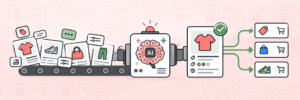
Google AI Max is a suite of AI-powered features within Google Ads Search campaigns.
It expands search term matching, generates additional ad copy and can select more relevant landing pages. It works inside a Search campaign; it is not a separate campaign type.
That extra reach can be useful when a campaign is already performing and you want to find more customers. But more clicks do not automatically mean better leads.
AI Max is now turned on by default for new Search campaigns, so review the selected features before launch. You need a clear definition of a valuable conversion, suitable landing pages and a plan for evaluating the traffic it brings.
At SOMO, our starting point is the business outcome: can the campaign generate additional qualified enquiries or sales at an acceptable cost? AI Max should earn its place against that measure.
What does AI Max do in Google Ads?

AI Max combines search term matching with asset optimisation. In practice, advertisers should understand three settings: search term matching, text customisation and final URL expansion.
These affect who sees your ad, what it says and where the click lands.
1. Search term matching: reach searches beyond your keywords
Search term matching uses broad match and keywordless technology to reach searches beyond your existing keyword coverage. Google draws on your keywords, ads and URLs to identify relevant queries.
For example, a business advertising hot water repairs might want to reach someone searching for an urgent repair over the weekend, even if that full phrase is absent from its keyword list.
The opportunity is a useful intent you have missed. The risk is paying for searches that share a topic but do not match what you sell.
2. Text customisation: AI-generated headlines and descriptions
Text customisation creates additional headlines and descriptions from your existing ads, website content and other campaign inputs. It was previously called automatically created assets.
This makes website accuracy part of ad quality control. An expired promotion, unclear eligibility statement or outdated service description needs fixing before it becomes source material for generated copy.
Keep your own strong ad assets and review the generated additions for accuracy, tone and relevance.
3. Final URL expansion: how AI Max chooses landing pages
Final URL expansion lets Google select another relevant page on your domain to match a search. For standard Search text ads, this can connect a specific query with a more suitable service or product page.
It requires text customisation so the message can match the selected destination. You can disable the setting and use URL exclusions to keep unsuitable pages out of expansion.
Careers, legal pages and outdated offers are sensible places to start your review; assess editorial pages against the campaign’s actual purpose.
AI Max vs Performance Max: what is the difference?
AI Max enhances Search campaigns. Performance Max is a separate campaign type that can reach customers across Google channels, including Search, YouTube, Display, Discover, Gmail and Maps.
| Factor | AI Max | Performance Max |
| Campaign setup | Features within Search | Separate campaign type |
| Channel scope | Search campaigns | Multiple Google channels |
| Main inputs | Keywords, ads and website content | Conversion goals, creative assets and relevant feeds |
| Testing question | Does expansion improve Search outcomes? | Does the broader channel mix improve business outcomes? |
With AI Max, the decision is whether additional automation can improve your Search results. With Performance Max, the decision also involves a broader channel mix and the creative assets needed to support it.
Choosing between Search and Performance Max involves channel coverage, creative requirements and how performance will be measured.
AI Max adds another option within that decision: expanding an existing Search campaign. Where both campaign types run, assess total account results to check whether growth is additional.
When to test AI Max
Our recommendation is to begin with an established Search campaign that has dependable tracking and a useful history of meaningful conversions. That gives you a stronger baseline for assessing whether expansion helps.
A good candidate has a clear offer, accurate landing pages, capacity to handle more customers and enough budget to support a controlled test. The team also needs time to assess search terms and sales feedback.
If your Google Ads are not generating leads, check tracking, search intent and landing page performance before expanding reach. Accounts attracting irrelevant enquiries or counting low-value actions as primary conversions need a stronger foundation for testing.
Bidding compatibility matters too. Google states that AI Max search term matching does not work with manual CPC bidding and recommends conversion or conversion-value-based bidding for its full capabilities.
Google AI Max settings and controls
When setting up a new Search campaign or enabling AI Max in an existing one, check brand settings, negative keywords, eligible landing pages, location targeting and generated ad wording.
These controls help align expanded reach with your business, keep unsuitable pages out of the customer journey and make the test easier to evaluate against qualified leads or sales.
Brand exclusions and negative keywords in AI Max
Decide whether the campaign should capture your own brand, competitor brands or neither. Brand inclusions and exclusions help steer this, while negative keywords remain available.
For a non-brand growth test, separate branded demand in your analysis. An increase in easy-to-convert brand searches can make results look stronger without demonstrating that you reached more new customers.
Build exclusions around clear business mismatches, such as services you do not provide. Avoid excluding a relevant query simply because it uses unexpected wording; assess intent and outcomes before removing useful reach.
URL exclusions: control which landing pages AI Max can use
Review the pages eligible for expansion and test the enquiry or purchase journey on each. Check that the service, offer and geographic coverage match the campaign.
If tracking templates are used, test that expanded destinations load correctly and retain the required tracking.
Location targeting and locations of interest in AI Max
AI Max also offers locations of interest at ad group level. Review these alongside campaign location settings. Interest in a place and physical presence there describe different customer situations, especially for local services and travel.
AI Brief: guide messaging and search intent
AI Brief lets you describe your business, audience and brand in your own words. It can guide both ad messaging and the searches AI Max matches your campaign to. For example, a repair business could explain that it provides emergency call-outs but does not sell spare parts. Check whether AI Brief is available in your account before designing a campaign around it.
Text guidelines for AI-generated ad copy
Where text guidelines are available, use specific instructions about generated copy. For example: “Do not mention specific prices” or “Do not describe the service as free.” These are illustrative instructions, not claims about any particular business.
Text guidelines only govern copy generation. For example, asking the tool not to address jobseekers can help keep the wording focused on customers, but it does not exclude job-related searches. Use negative keywords and search targeting controls to manage those searches.
Pinned headlines and required ad wording
Check mandatory wording separately. Pinned responsive search ad assets may not be used when final URL expansion selects a different page; URL inclusions can also affect pinning.
Where available, assess text disclaimers for required wording. If the configuration cannot meet your requirements, keep the relevant automation disabled.
How to set up an AI Max campaign experiment
- Define a measurable goal. Decide what AI Max needs to improve, such as qualified enquiries at an acceptable acquisition cost. Set the conversion definition, test budget, review dates and stopping conditions before launch.
- Choose an eligible campaign and experiment. Start with dependable tracking and a useful conversion history. Where available, use an AI Max experiment to compare your existing settings with an AI Max treatment.
- Configure the features and controls. In the campaign’s AI Max settings, review search term matching, text customisation and final URL expansion. Set brand exclusions, negative keywords, eligible landing pages and location controls to match the test’s purpose.
- Check the customer journey. Test landing pages, forms, calls and conversion tracking. Review generated copy and required wording. Confirm that expanded URLs work with your tracking templates before the test begins.
- Launch with a stable baseline. Avoid changing your offer, conversion goals, landing pages and budget at the same time. Record any necessary changes so you can account for them when interpreting results.
- Review learning and business outcomes. Google recommends at least two weeks for ramp-up before routine changes. Set the full evaluation period around conversion volume and sales lag, then compare qualified leads, sales and acquisition cost. Act promptly on broken tracking, inaccurate claims or clear business mismatches.
Measuring AI Max performance and lead quality
Review the journey from query to customer. Google Ads reports can help explain what AI Max matched, which copy appeared and which page received the click.
| Report | What to review | Decision it supports |
| Search terms | AI Max matches, Source, headlines and destinations | Identify useful intent and clear mismatches |
| Keywords | Expanded-match and landing-page-match totals | Understand the source of additional traffic |
| Assets | Generated copy, accuracy and performance | Remove unsuitable headlines and descriptions |
| Landing pages | Selected URLs and conversion journeys | Refine eligible destinations |
For lead generation, connect this reporting with CRM outcomes. Track qualified lead rate, cost per qualified lead, appointments and eventual sales where the data is available. For ecommerce, assess revenue and profitability alongside conversion value.
Consider an illustrative example: one campaign produces 20 leads and 10 qualify; another produces 30 leads and only six qualify.
The second delivers more form submissions but fewer usable opportunities. Compare acquisition cost and eventual sales before declaring it the winner.
Engagement data can help flag a mismatch, but a short session alone does not prove poor quality. Someone may call quickly, complete a simple purchase or find the answer they needed. Use behaviour alongside the actual outcome.
Common AI Max mistakes and how to avoid them

- Optimising for the wrong conversion: If every form submission has equal value in your reporting, you may miss a shift towards unsuitable enquiries. Agree what qualifies before launch.
- Overlooking brand overlap: Separate brand and non-brand results when assessing additional reach.
- Leaving website content unchecked: Generated ads can expose gaps in the information on your pages.
- Expanding a constrained campaign without a budget plan: Decide how much experimentation the business can fund and what success would justify.
- Judging the first few days as a final result: Allow for conversion lag and learning, while acting on broken tracking, inaccurate claims or clear business mismatches.
Is AI Max replacing Dynamic Search Ads?
Google has announced a transition from Dynamic Search Ads to AI Max. Its updated timeline states that DSA sunset and automatic upgrades begin in February 2027.
Automatic upgrades for campaigns using automatically created assets and the campaign-level broad match setting began in September 2026.
The DSA-to-AI Max transition needs a settings review: confirm which features are enabled and how they affect your current campaign before the upgrade.
Is AI Max right for your business?
AI Max is worth testing when the campaign has a reliable foundation and a clear growth question. Its success should show up in additional qualified enquiries, sales or profitable revenue, with an acceptable cost of acquisition.
If the current campaign is struggling, start by finding the cause. If it is performing well, protect that baseline while you test whether broader matching and more adaptive creative improve the result.
SOMO’s paid search team can review your tracking, campaign structure and landing pages, then help plan an AI Max test around the outcomes your business needs.
Google AI Max FAQs
Is AI Max a new Google Ads campaign type?
No. Google AI Max is a suite of features within Search campaigns, not a separate campaign type. It adds search term matching, text customisation and final URL expansion to your Search setup.
Advertisers can review these settings individually, retain their campaign structure and test whether the additional automation improves qualified leads, sales or conversion value.
Is AI Max the same as broad match?
No. Broad match is one part of AI Max’s search term matching, which also uses keywordless technology to identify relevant searches.
AI Max extends beyond matching by offering text customisation and final URL expansion. This means it can influence the searches your ads appear for, the copy people see and the landing pages they reach.
Can you turn off individual AI Max features?
Yes. You can disable search term matching at ad group level and manage text customisation and final URL expansion at campaign level. The settings have dependencies: final URL expansion requires text customisation.
Before saving changes, check the resulting configuration and confirm that your brand settings, landing page controls and required ad wording still work as intended.
Does AI Max guarantee better leads?
No. AI Max can expand reach, but better lead quality depends on your offer, conversion tracking, campaign controls and the people those searches attract.
Measure qualified enquiries, appointments and sales alongside Google Ads conversion totals. A lower cost per form submission can still produce a higher cost per customer if fewer enquiries become suitable opportunities.
Does AI Max improve organic rankings or guarantee AI citations?
AI Max is designed for paid Search advertising, so activating it does not guarantee higher organic rankings or citations in AI generated answers. Those outcomes require a separate approach to website content, technical accessibility and visibility measurement.
Evaluate AI Max against advertising goals, such as qualified enquiries, sales and profitable revenue, while tracking organic performance separately.